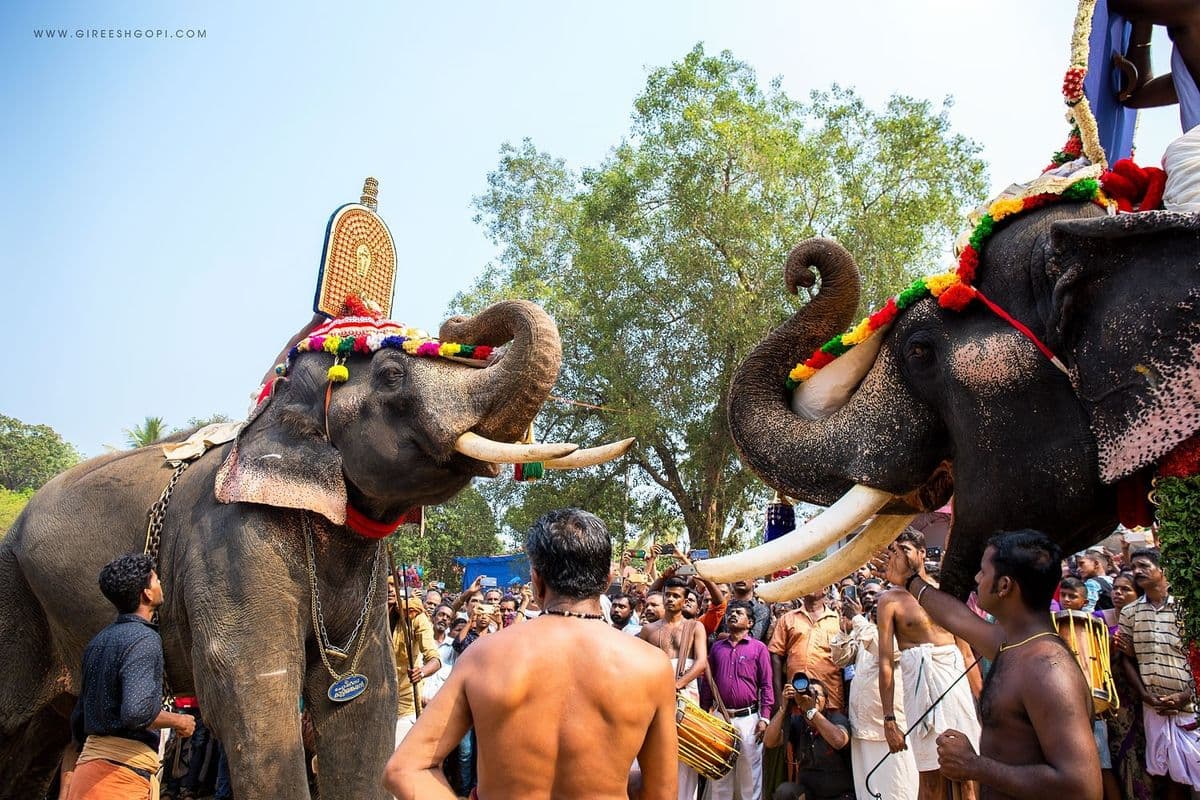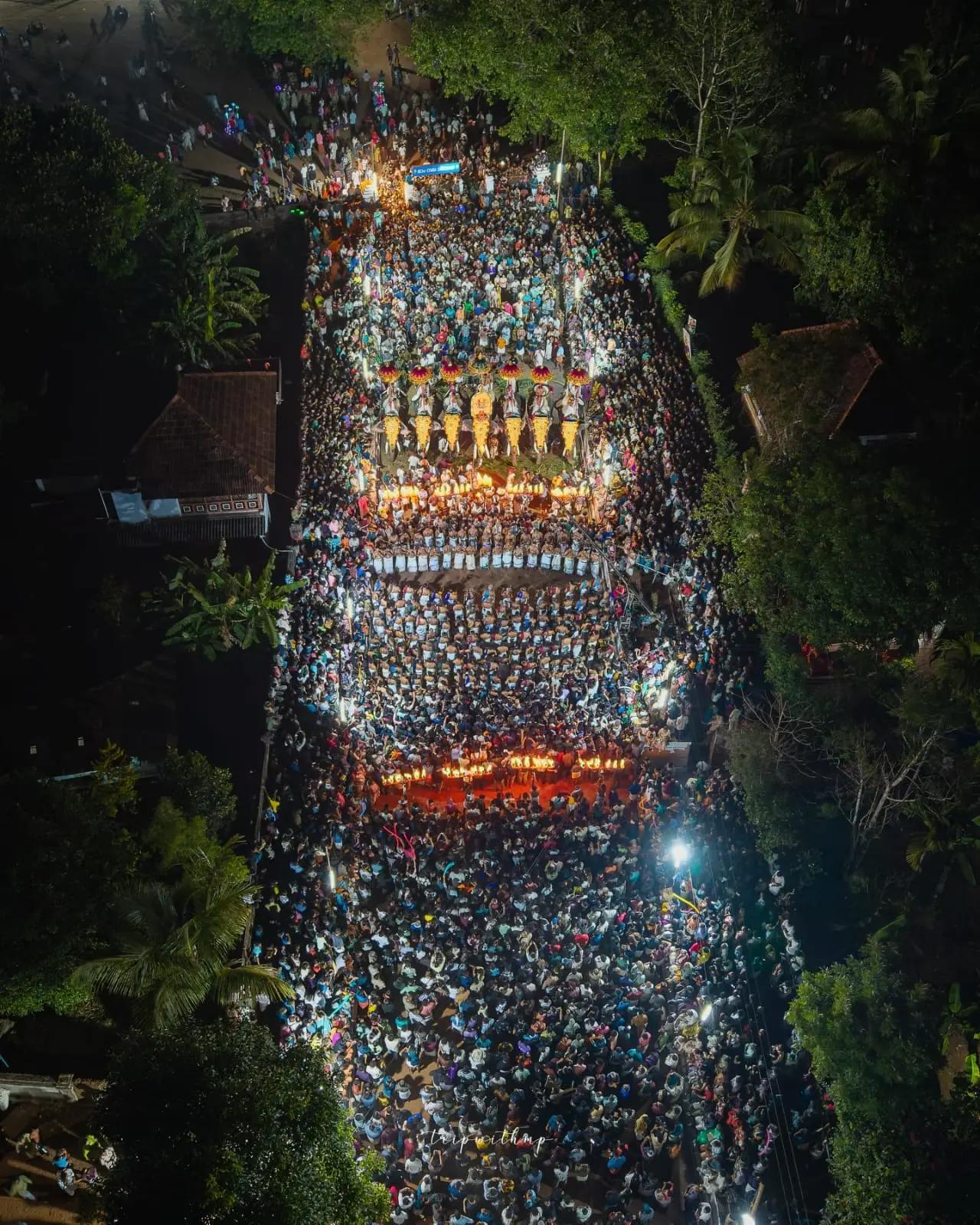
Peruvanam Pooram in the Cherpu region — a festival-season view, not a year-round scene.
What makes Cherpu special? Its carved wooden elephants, the Peruvanam Pooram tradition and Thiruvullakkavu’s first letters reveal a village worth knowing beyond a map pin.
A wooden elephant is a good place to begin a story about Cherpu. Not the animal moving through a festival crowd, but the small one you can hold in your hand: a curved trunk, a broad forehead, feet that make it seem heavier than it is. You might have seen one in a Kerala souvenir shop without wondering where it began. Follow that question south of Thrissur, and it brings you to Cherpu. What looked like a keepsake turns out to be an introduction to a village and the people who know how to shape it.
Cherpu is in Thrissur district, close to Peruvanam, in a landscape where temple festivals, craft and learning are not separate attractions. They overlap. A visitor searching for ‘things to do in Cherpu’ can certainly make a list of places, but the list alone misses something. The more rewarding question is what this place takes care of. Three answers stand out: work done patiently by hand, rhythms carried across generations, and the hopeful moment when a child begins to read and write. Those are ordinary human things. Here, they have a particularly visible life.
An artisan studies a curve. A musician waits for the right beat. A child tries a first letter.
The elephant you can take home
Kerala Tourism identifies Cherpu with its wood-carved elephants, made from teak or rosewood by artisans whose skills pass from one generation to another. The range extends from miniatures to life-size models. That detail is worth pausing over. A small souvenir and a large sculpture demand different decisions, but both depend on noticing an animal properly: the weight of its body, the shape of an ear, the way a trunk turns. The craft is not simply to make something recognisable. It is to persuade an unmoving piece of wood to suggest a living presence.
For a visitor, that changes the way you look at the finished object. Instead of asking only the price, you can ask who made it, which wood was used and how long it took. If a workshop visit is available, arrange it first and ask permission before photographing anyone at work. A workshop is someone’s workplace, not a stage waiting for tourists. Buying directly from an artisan, where possible, also gives the souvenir a name and a conversation. Years later, the elephant on a shelf can still bring that meeting back to mind.
A village that knows how to listen
The second introduction is a much larger elephant — the one associated with the festival season. Peruvanam Temple is in the Cherpu area, and its pooram is one of the region’s great cultural gatherings. Kerala Tourism describes Peruvanam Pooram as a tradition more than 1,400 years old. That is a published account of the festival’s antiquity, not a reason to turn every local story into a dated historical fact. What a visitor can encounter more directly is the relationship between neighbouring temples, processions and the music that holds people’s attention long into the night.
Panchari and Pandi Melam are central to that experience. A melam is not background music while the ‘real’ event happens elsewhere. It is an event in its own right, built by percussionists and other instrumentalists listening closely to one another. The pleasure lies partly in waiting: hearing a pattern settle, recognising a change, noticing the crowd respond. You do not need technical knowledge to begin listening. Nor should you expect to understand everything in one evening. A village tradition does not become less interesting because it takes time to learn its language.
Where a child begins with a letter
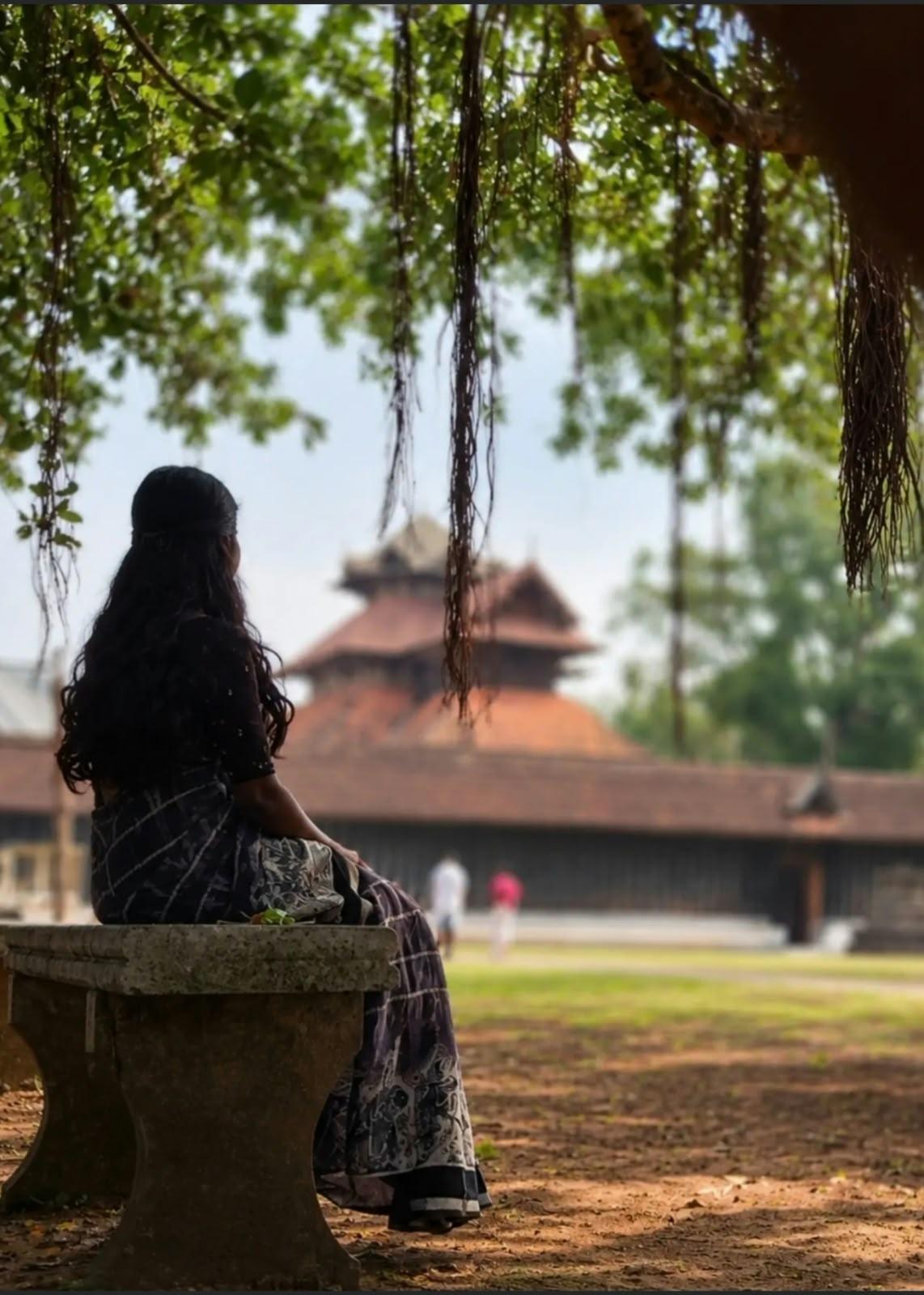
Then there is a quieter kind of beginning at Thiruvullakkavu Dharma Sastha Temple in Cherpu. The temple is known for Vidyarambham, the initiation into learning, especially around Vijayadasami. Kerala Tourism’s festival account describes children’s first writing and the cultural programmes associated with Navarathri. The scale can be large, but the meaning is intimate: a child’s fingers are guided towards letters, and a family marks the start of something that will occupy a lifetime. After the force of a festival drum, this small gesture offers another way of understanding what a community values.
Woodcarving, melam and first letters might seem an unlikely trio. Yet they share a familiar shape. Someone who knows a little more helps someone who is beginning; an awkward movement becomes more certain through repetition; attention gradually becomes skill. This is not a claim that every household in Cherpu practises the same arts, or that village life stands outside modern change. It is a way of seeing why these particular traditions matter. They make learning visible, whether the learner holds a carving tool, a pair of drumsticks or a finger above a plate of rice.
Visiting Cherpu, without rushing it
If you are planning a visit, use Thrissur as your main transport reference and confirm the local journey to Cherpu before setting out. Choose a small number of stops rather than trying to collect every temple in an afternoon. For places of worship, check opening times, entry rules and photography restrictions locally. Pooram dates follow the festival calendar and need to be verified each year; a January trip should not be planned on the assumption that the pooram will be taking place. Leave room for pauses, and remember that private homes and workshops are not automatically open to visitors.
For PIVF, Cherpu is not merely a convenient address outside the city. It is the setting in which the Peruvanam International Village Festival brings reading, art and conversation into contact with a living local culture. The 2027 edition takes place on 8–10 January at Sreelakam Lifelong Learning Institute, near Sree Cherpu Bhagavathi Temple. PIVF is a separate festival, not the temple pooram, and it offers a different reason to spend time here: listening to people and ideas in the same region that has nurtured other forms of listening for generations.
So what is special about Cherpu? You can answer with names: wooden elephants, Peruvanam, Thiruvullakkavu. But the names become more memorable when you notice the human work inside them. An artisan studies a curve. A musician waits for the right beat. A child tries a first letter. None of these needs a grand slogan to be moving. Together they suggest a village whose gifts are best discovered with a little time, a few respectful questions and the willingness to look more closely than a passing photograph allows.
Sources & further reading
Spend a little longer with the village
About the author
PIVF Journal
Culture & Heritage
Stories about the places, arts and reading life around the Peruvanam International Village Festival, drawing on published cultural references and PIVF’s festival material.